Agentic AI for Productivity

Agentic ai transforms how people manage attention and productivity. They see a shift from manual tasks to strategic decisions as ai automates routine work. Many industries report over 20% improvement in efficiency thanks to agentic ai. Protecting attention becomes easier when ai handles repetitive chores, letting individuals focus on high-value actions. Agentic AI for Personal Productivity helps teams measure attention and productivity, supporting smarter, faster results. Protecting attention means using ai to guard time and energy, which leads to better outcomes. Agentic ai keeps attention on important goals, automates processes, and helps track productivity. Protecting attention gives people more space to innovate and collaborate. Attention remains vital, and agentic ai offers tools to boost productivity while protecting attention.
Key Takeaways
Agentic AI automates routine tasks, allowing teams to focus on high-value work and improve productivity by over 20%.
Delegating repetitive chores to AI can increase productivity by up to 73%, freeing time for strategic planning and innovation.
Setting clear goals for AI projects helps teams measure success and ensures that AI supports their objectives effectively.
https://amzn.to/4pLs8qg
Agentic AI for Personal Productivity
Focus on High-Value Tasks
Agentic ai for personal productivity helps people shift their attention from repetitive chores to meaningful work. When ai agents take over routine jobs, teams can focus on projects that need creativity and problem-solving. Many professionals use agentic ai for personal productivity to boost focus and spend more time on deep focus activities. For example, in talent acquisition, ai agents can rank applicants and set up interviews. In IT service management, ai agents handle user account changes and access requests. These tasks free up time for strategic planning and innovation. People notice that when ai handles the admin, they get uninterrupted focus and can deliver better results. Boosting focus becomes easier when ai agents support daily routines.
Delegate Routine Work to AI
Delegating routine work to ai agents is a smart move for anyone who wants to improve productivity. Studies show that ai agents can increase productivity by up to 73%. The chart below shows how different companies benefit from agentic ai for personal productivity:
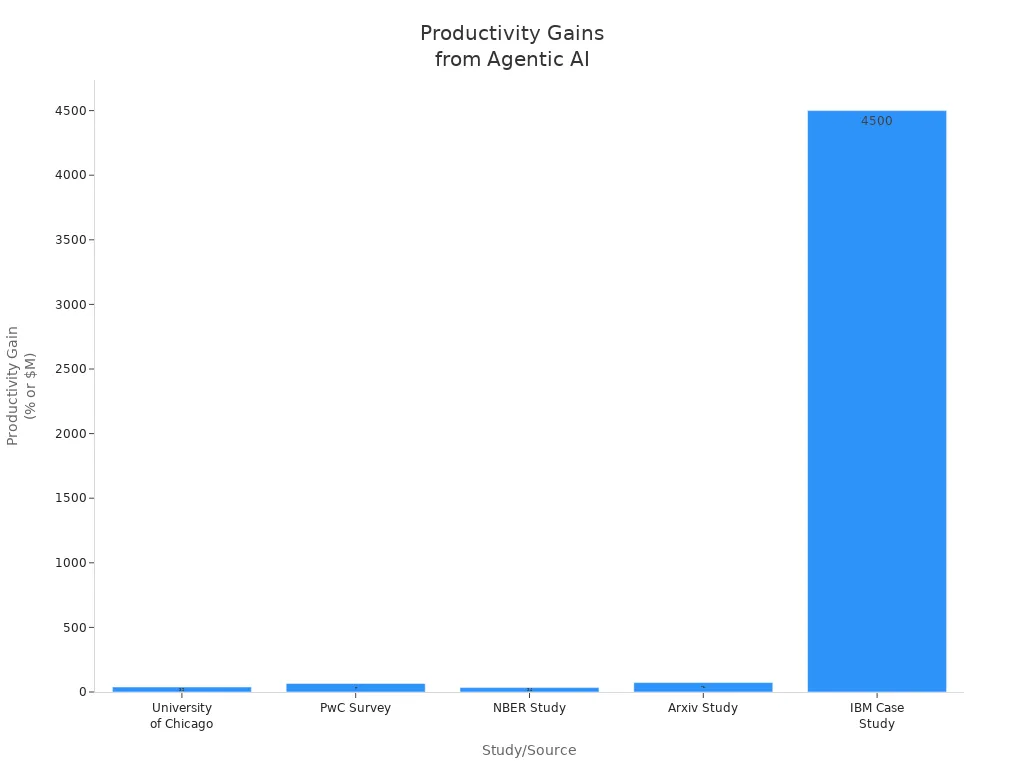
People use ai agents for tasks like lead qualification, support triage, proposal building, and CRM updates. Ai can help sort tasks and automate end-to-end processes, such as ticket triage and scheduling. Ai agents also analyze data for demand forecasting and optimize logistics in real time. To find tasks for delegation, teams look at human baseline time, probability of success, ai process time, and clear instructions. Ai should give you breathing room so you can focus on what matters. Ai can generate daily action lists, making it easy to stay organized. When ai handles the repeatable, people can focus on high-value work. An autonomous ai assistant can help teams reach new levels of productivity with agentic ai for personal productivity.
Streamline Workflows with Agentic AI
Integrate Apps, Data, and AI Agents
Teams often struggle with disconnected apps and scattered data. Agentic ai brings everything together, making workflows smoother and more reliable. They use platforms that unify ai tools, reducing errors and boosting productivity. Modular workflows help break down big tasks into smaller steps, which makes updates easier. Many companies track costs in real time to avoid budget surprises. Governance comes first, so audit trails and compliance checks keep data safe. Community-driven frameworks like LangChain and Ollama let teams switch between models without changing their whole system. Over half of developers use Ollama, showing how popular these solutions are for business automation. Common challenges include poor data quality, lack of expertise, and high costs. Security and transparency matter, so organizations focus on removing friction and keeping everything visible.
| Workflow Bottleneck | Solution Provided by Agentic AI |
|---|---|
| Managing complex, multi-step workflows | Optimizes data pipelines for real-time agent access |
| Ensuring data quality | Eliminates silos that prevent cross-functional coordination |
| Maintaining regulatory compliance | Ensures data quality at the velocity agents demand |
Simplify Complex Processes
Agentic ai helps companies streamline processes by automating steps that used to take hours. In transportation, ai agents optimize delivery routes and negotiate rates, leading to faster deployment and lower costs. Healthcare teams use ai to automate administrative work and access large datasets, saving time and reducing errors. Finance professionals rely on ai to manage portfolios and analyze market data, which improves decision-making. Task decomposition breaks big goals into smaller tasks, making everything clearer. Agent coordination keeps all agents working toward the same business objective. Removing friction from workflows means less confusion and more focus on results.
| Industry | Application | Benefits |
|---|---|---|
| Transportation | AI agents optimize delivery processes in real-time, adjusting for various factors. | Faster deployment, reduced expenses, and improved negotiation of rates. |
| Healthcare | AI agents automate administrative tasks and provide access to large datasets. | Significant time savings, reduced errors, and enhanced patient care through automation. |
| Finance | AI agents manage investment portfolios and analyze market data. | Tailored financial strategies and improved decision-making based on real-time data analysis. |
Automate Task Management
https://amzn.to/4qaToip
Agentic ai makes task management easier by automating assistance and organizing daily work. Teams see a 40-60% reduction in time spent on routine tasks. Decision-making gets faster with real-time data analysis. Employee satisfaction rises because they focus on strategic work instead of repetitive chores. Automation helps companies reach goals quicker and with fewer mistakes. Continuous integration and deployment pipelines retrain models automatically, so performance stays high. Automating testing cuts delays and helps more models reach production. Business automation means teams spend less time on manual work and more time on innovation.
“Moxo has helped us completely streamline our project management and client communication process. It’s made our workflows much more organized, our team more accountable, and our clients more informed.”
Teams measure success by looking at task completion rates, error rates, and human hours saved. Customer satisfaction and revenue impact also show how well ai streamlines workflows. Removing friction and automating steps lets teams focus on what matters most.
Boost Productivity Through Continuous Improvement
Iterate AI Tools and Workflows
Teams that want to get the most out of ai know that improvement never stops. They use a mix of methods to keep their ai agents sharp and their productivity high. The table below shows three top approaches:
| Methodology | Description |
|---|---|
| Continuous Learning Flywheel | Agents learn from data, workflows, and user actions, building a memory that grows over time. |
| Centralized AI Governance | Workflows stay documented and standardized, making it easier to manage ai agents. |
| Integration of Business Context | Agents use domain knowledge and feedback to improve and make better decisions. |
Teams also rely on features like autonomous decision-making, reasoning engines, and integrated multitasking. These help agents handle complex tasks and adapt as things change. Adaptive learning lets ai refine its plans, leading to faster decision-making and better results.
Common challenges can slow down progress. Data quality matters, so teams clean their data and set strong rules. Sometimes, ai tools get out of hand, so companies give clear guidelines and approved tools. Trust grows when teams validate ai outputs and keep things transparent. Shadow ai and data leaks can cause problems, but training and clear policies help keep everything safe.
Feedback loops are what turn behavior into improvement. That means the agent can:
See the outcome of its actions
Compare outcome vs goal
Detect mistakes, drift, or weak decisions
Adjust prompts, plans, or tool use
Get better over time, not just run again.
Share Best Practices and Success Stories
Sharing what works helps everyone move forward. Teams often hold regular meetings to talk about ai wins and lessons learned. They create playbooks with tips for faster decision-making and higher productivity. Some companies set up forums or chat groups where people can ask questions and share insight.
Success stories inspire others to try new things. For example, a retail team used ai to automate inventory checks. They saw faster decision-making and fewer errors. Another group in finance shared how ai agents helped them spot trends, leading to smarter investments. When teams share best practices, they build a culture of learning and growth. This keeps productivity rising and helps everyone get more value from ai.
Measure Productivity Impact with Agentic AI

Track Key Performance Indicators (KPIs)
https://amzn.to/4pcokNT
Teams want to see real results when they use ai to boost productivity. Tracking the right KPIs helps them understand where ai makes the biggest difference. They often look at user satisfaction, strategic goals, task performance, technical performance, and business impact. These categories show how ai improves both daily work and long-term outcomes.
| KPI Category | Metrics | Examples |
|---|---|---|
| User Satisfaction | NPS, CSAT, CES, Retention rate, Abandonment rate | Agent achieves CSAT of 4.2/5, higher than human agents at 3.8/5 |
| Strategic Goals | Market differentiation, Speed to market, Scalability, Innovation metrics | Agent enables 24/7 support in 15 languages without hiring multilingual staff |
| Task Performance | Task Success Rate, Accuracy, Completeness, Relevance | Agent achieves 87% task success on simple queries, 72% on complex queries |
| Technical Performance | Precision, Recall, F1 Score, AUC-ROC | Agent cites pricing with 98% accuracy but product availability with only 83% accuracy |
| Business Impact | ROI, Customer satisfaction scores, Cost reduction | Cost reduction through automation is highly measurable and verifiable |
Teams set measurable agent objectives to keep ai focused on clear goals. This approach helps everyone see how ai supports analysis and drives better productivity.
Analyze Time Saved and Efficiency Gains
Measuring time saved and efficiency gains gives teams a clear picture of ai’s impact. Many organizations track time savings, error reduction, and faster deployment. They also review logs every quarter to find new ways to improve.
| Sector | Average Time Saved per Year | Percentage Reduction |
|---|---|---|
| Legal and Tax | 240 hours | N/A |
| Knowledge Workers | 3.6 hours/week | 31% |
| Marketing Teams | 11 hours/week | N/A |
Teams use these methods to measure efficiency:
Set KPIs for time savings and error reduction
Analyze logs quarterly to spot trends
Track business efficiency metrics like fewer handoffs and escalations
Measure time to deploy and time to value
When ai handles repetitive work, teams see more productivity and higher efficiency. They spend less time on manual tasks and more time on what matters most.
Set Clear Objectives for AI Productivity
Define Goals and Outcomes
Teams boost productivity when they set clear goals for ai projects. They start by deciding what they want the agent to achieve. For example, an agent can gather research, organize sources, and keep information current. Another agent acts as a tutor, planning study sessions and adjusting lessons as progress happens. Some agents help people stay organized by managing schedules and prioritizing tasks. Support agents handle customer questions and improve responses over time. Writing agents draft and edit documents in the user’s tone of voice. Creative agents brainstorm ideas and refine them with feedback. Data agents track business trends and deliver summaries automatically. These examples show how ai supports clearer communication and helps teams reach their goals faster.
Tip: Teams should write down their goals and outcomes before launching any ai project. This step helps everyone understand what success looks like.
Ensure Resources and Minimize Costs
Teams need to manage resources and keep costs low to get the most from ai. They use several strategies to make this happen:
Generate multiple candidate actions for agents to choose from, which increases flexibility.
Estimate costs for each action, including token usage and tool calls, using past data or simulations.
Assess the expected value of outcomes, scoring each option for accuracy and completeness.
Set strict budget limits for tokens, time, and calls, then optimize action sequences to fit these limits.
Select plans that balance cost and benefit, sometimes using dynamic programming for efficiency.
Test agents in real-world scenarios to refine estimates and improve reliability.
Teams also embed governance policies into agents from the start. They monitor runtime usage because every interaction adds to costs. Investing in reliability management prevents downtime and unpredictable behavior. Funds go toward maintenance and upgrades to keep technology current. Efficient customer support helps maintain trust and adoption. These steps support clearer communication and keep productivity high.
| Strategy | Benefit |
|---|---|
| Action Generation | More options for agents |
| Cost Estimation | Predicts and controls expenses |
| Benefit Assessment | Scores quality of outcomes |
| Budget Constraints | Keeps spending in check |
| Plan Selection | Balances cost and value |
| Real-World Testing | Improves reliability |
Teams boost productivity by defining clear objectives, leveraging autonomous ai agents, and focusing on continuous learning. Production monitoring and ongoing measurement help ai adapt and improve. Organizations see ai evolve, automate workflows, and drive long-term productivity. Starting small, sharing best practices, and iterating with ai unlocks real results.
| Trend | Description |
|---|---|
| Market Evolution | ai automates complex workflows for higher productivity |
| Investment Activity | Strong investor confidence in agentic ai models |
| Product Development | ai applications improve outcome measurement |
FAQ
How can teams start using agentic AI for productivity?
Teams can begin by identifying repetitive tasks, choosing an agentic AI platform, and setting clear goals. Small pilot projects help build confidence and show quick wins.
What are common mistakes when integrating agentic AI?
Many teams skip training or ignore feedback. They should monitor results, adjust workflows, and encourage everyone to share best practices for better outcomes.
Does agentic AI work with existing business tools?
Yes, agentic AI connects with popular apps and data sources. Teams use integrations to automate workflows and keep information up to date.
Conclusion
In conclusion, leveraging Agentic AI for productivity presents a transformative opportunity for individuals and organizations alike. By incorporating this advanced technology, users can streamline tasks, optimize workflows, and enhance overall efficiency. As Agentic AI continues to evolve, it promises to offer even more innovative solutions tailored to the diverse needs of its users. Embracing these advancements not only fosters productivity but also empowers individuals to achieve their goals with greater precision and effectiveness. As we look to the future, the integration of Agentic AI into our daily routines stands as a testament to the boundless potential of artificial intelligence in reshaping the landscape of productivity.