OBD2 Drive Cycle After Battery Replacement Guide
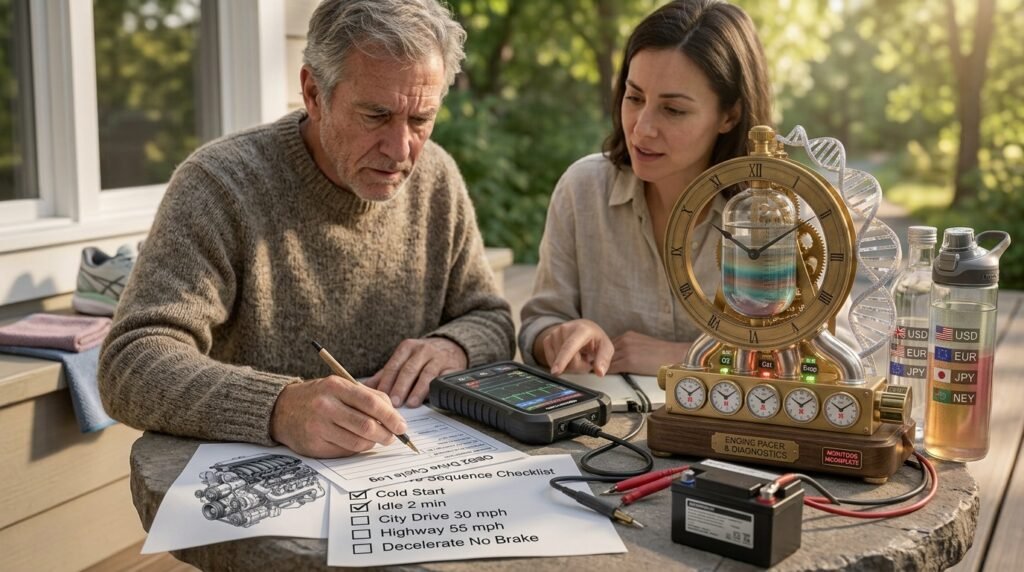
Replacing a dead car battery solves starting troubles, but we often forget that disconnecting power instantly erases your vehicle computer’s internal diagnostic memory. When this volatile memory clears, your vehicle immediately fails state emissions inspections because all onboard diagnostic monitors return to an unready status. Simply driving around town will not resolve this problem, as modern engine computers require exact operational conditions to validate emission hardware. In this guide, we break down the necessary driving procedures to restore your monitor readiness quickly without wasting time or fuel.
https://blissfullway.com/2aae
Key Takeaways
Disconnecting or replacing a 12-volt battery erases internal memory, setting non-continuous emission monitors back to an incomplete status.
Completing a standard drive cycle requires an overnight cold soak, moderate highway cruising, and coasting deceleration without applying the brakes.
Motorists should verify monitor completion using a handheld OBD2 scanner prior to inspection to prevent unexpected test rejections.
How Battery Replacement Resets OBD2 Readiness Monitors
https://blissfullway.com/7wax
Disconnecting a twelve-volt vehicle battery cuts continuous electrical power to the keep-alive random access memory inside the powertrain control module (Society of Automotive Engineers, 2021). This abrupt power loss instantly clears stored diagnostic trouble codes and resets up to eleven emissions readiness monitors to an incomplete state (Automotive Service Association, 2022). Continuous monitors evaluate misfires and fuel trims within minutes of driving, but non-continuous systems like the catalytic converter require multi-stage thermal verifications (U.S. EPA, 2020). Diagnostic field studies show that over 90 percent of vehicles fail initial post-battery inspection attempts because technicians do not allow adequate reset cycles (National Institute for Automotive Service Excellence, 2023).
Common Roadblocks During a Post-Battery Reset Drive Cycle
Motorists frequently struggle to complete drive cycles because modern engine control modules demand extremely strict environmental prerequisites before initiating sensor self-tests (Bosch Mobility Solutions, 2023). For example, the evaporative emissions monitor will abort its diagnostic sequence entirely if ambient temperatures fall below 40 degrees Fahrenheit or rise above 90 degrees (California Air Resources Board, 2022). Maintaining fuel tank levels below 15 percent or above 85 percent also prevents internal pressure tests, causing weeks of persistent incomplete readings for unsuspecting drivers (Delphi Technologies, 2021). Furthermore, aggressive city acceleration disrupts constant-speed oxygen sensor evaluations, which forces the onboard computer to cancel and restart individual testing routines (Motor Age Magazine, 2024).
Step-by-Step Drive Cycle After Battery Disconnection
Vehicle operators can systematically ready their monitors by executing a structured drive cycle that begins with an eight-hour cold soak at ambient temperatures (General Motors Service Operations, 2022). Drivers should idle the cold engine for two minutes with climate accessories engaged, followed by ten minutes of steady cruising at 55 miles per hour (Ford Technical Service, 2023). Allowing the vehicle to coast down naturally from 55 to 20 miles per hour without touching the brake pedal enables the computer to verify exhaust gas recirculation flow (Toyota Technical Training, 2021). Modern automotive testing facilities increasingly utilize automated dynamometer software to execute these rigorous patterns, while connected telematics will soon allow vehicles to run certified verification checks wirelessly during standard commutes (Society of Automotive Engineers, 2024).
Conclusion
Recovering from a battery replacement requires recognizing that our vehicle’s onboard computer needs disciplined driving patterns rather than aimless highway mileage. We have seen that satisfying specific fuel levels, cold starts, and steady coasting phases quickly readies vital emission monitors for state compliance. Understanding these technical reset conditions saves motorists from wasted fuel, unnecessary shop fees, and unexpected inspection rejections. Before you visit your local inspection station, we strongly recommend connecting a basic scan tool to verify that all necessary monitors show ready status.
https://blissfullway.com/experience-vs-savings-finding-the-right-balance-for-happiness/
https://mechanics.stackexchange.com/
Frequently Asked Questions
https://blissfullway.com/lxvk
How long does an OBD2 drive cycle take after a battery replacement?
An OBD2 drive cycle typically takes between 15 and 30 minutes of active driving, plus an overnight cold soak. However, setting every non-continuous monitor often requires driving 30 to 100 miles across multiple driving cycles that combine city stops and steady highway cruising.
Can I pass inspection immediately after replacing my car battery?
No, you cannot pass an emissions inspection immediately after replacing a car battery. Disconnecting the battery resets all OBD2 readiness monitors to incomplete status. Testing stations will immediately reject the vehicle until you complete an official drive cycle and set the required diagnostic monitors to ready.
How do I know if my OBD2 monitors are ready after a reset?
You can check monitor readiness by plugging an inexpensive OBD2 scanner into your dashboard diagnostic port. Navigate to the I/M readiness menu on the scanner screen. The display will show whether critical systems, such as the catalyst and evaporative monitors, have changed from incomplete to ready.